Join Our Family
My Account
Molly Brave logo
  • Home
  • About Us
  • Store
  • Blog
  • Activities
  • Contact
  • Blog

    • All Categories
    • For Parents and Teachers
    • Recommended Books
    • Resources
    • News
    • Mentorship With Mary Alice – An Introduction
      • How To Begin Writing For Children
    • Independent, Hybrid and Self-Publishing

Tag: Publishing Perspectives

Wattpad’s New Video App, Raccoon, Launches in the US Today

Published on August 29, 2017 | In Blog, News | 0 Comment

In Feature Articles by Porter Anderson August 25, 2017

Moving beyond written stories, Wattpad’s Raccoon video storytelling app encourages storytelling in the context of selfie-video, close to the hearts of YouTube fans.

Selfies on Steroids

At last weekend’s Writer’s Digest Annual Conference in New York, two 40-something authors were overheard between sessions talking about Toronto-based Wattpad. They’d just attended a session in which the service was discussed.

“I just found out Wattpad has a lot of millennial readers,” one said.

“Yeah,” said the other writer, “and it’s all about serials,” said the other. “Did you know that?”

Such is the peculiar, almost cult-like progress of the world’s largest reading and writing platform. Wattpad’s massive reach has grown even larger in its deals with major traditional publishers such as Hachette in France.

Today, the Canadian company’s most active market, the US, gets access to Raccoon, a new video app for storytelling. Raccoon? Think raconteur, we were told when Publishing Perspectives asked. “And it’s also a nod to Wattpad’s homebase in Toronto,” a spokesperson told us, “which is known for its raccoons.”

Wattpad co-founder (with Allen Lau) Ivan Yuen tells us, “Raccoon’s focus is to deliver real stories from real people, and it’s a critical step forward in realizing Wattpad’s vision to connect and entertain the world through stories.

“As we look to the future of storytelling,” he says, “it’s clear that video will play an important role—digital video audiences are predicted [by eMarketer digital research] to reach 2.15 billion this year alone.”

Raccoon, for iOS and Android, is the most serious leap yet for the operation into visual storytelling. While writing and words have been at the heart of the Wattpad universe to date, Raccoon lets users create and share videos to tell their own stories. These are vertical selfie videos with which users express what Wattpad calls “their genuine selves, allowing them to make authentic connections with others.”

Raccoon is expected to be adding themes and prompts that users can deploy to enhance and embellish the stories they create in and about their own lives and worlds.

Wattpad tell Publishing Perspectives that in an early rollout in Canada, the service picked up fast traction in storytelling focused around four areas:

  • Travel
  • Parenting
  • Childhood stories (“millennial memoir,” you read it here first)
  • Personal challenges

In that last category, personal challenges, we see another interesting potential convergence in the offing. Many Wattpad fans are also major consumers of YouTube, and the typical YouTube star is a popular performer of what amounts to selfie videos—exactly the medium that Wattpad is asking its users to incorporate into their own storytelling with Raccoon. Expect the Wattpad-YouTube axis to heat up quickly.

In their contacts this week with journalists about Raccoon, Wattpad’s spokespeople refer to the new app as “a major foray into nonfiction storytelling.”

“By providing a platform where people can experiment with new forms of short-form video storytelling,” says Yuen, “Raccoon creates authentic connections between storytellers and their audiences, and cultivates a safe space for people to tell stories around shared experiences.”

Storytelling as Story-Showing
“It’s clear that video will play an important role—digital video audiences are predicted to reach 2.15 billion this year alone.”Ivan Yuen

Unlike our wide-eyed authors at the conference, Publishing Perspectives readers know a great deal about Wattpad.

And its numbers tell an impressive story about Wattpad’s global success. UPDATE: A few hours after this story was published Wattpad sent us new numbers. These are freshly updated on August 25 at midday Eastern time:

  • More than 60 million active users monthly
  • More than 15.5 billion minutes spent monthly on the platform
  • More than 400 million uploads shared on the platform
  • More than 50 languages supported in stories and continual chatter between readers and the authors

At the moment, Wattpad spokespeople say they have no plan to attach a paid subscription to Raccoon, which is a departure from the model for their next-to-newest feature, Tap.

Tapping Deeper Into Mobile

Today’s US rollout of Raccoon follows the late-July activation of Wattpad’s Tap Originals, the enhanced chat-fiction functionality that lets users incorporate audio, photos, video, voice notes, and alternative ending options into their stories.

The initial Tap app from Wattpad was released in February, and it vies in the App Store with such services as Hooked and Yarn. Tap Originals are available in 10 or more languages. And Tap has an optional subscription model attached to it, the latest move in Wattpad’s gradual build up of revenue streams. A spokesperson for the company gives us a quick explanation of out the Tap subscription options work.

From Wattpad’s Raccoon

Each user has a certain amount of taps loaded onto their account. You tap to get a new installment of a texted story. Once your account’s taps are used up, you need to reload them. Taps are reloaded after a certain period of time passes, or if the user purchases a subscription to Tap Premium. So Tap Premium is the way to get your story’s next increments without waiting. By subscribing to Tap Premium, users receive unlimited taps to power through their stories without interruption.

There are three Tap Premium subscription packages, and each package offers unlimited taps:

  • US$2.99 per week
  • US$7.99 per month
  • US$39.99 per year

If you find it tricky to keep up with the accelerating arrival of new wrinkles in Wattpad’s offering, keep in mind that the core concept has to do with closing the gap between creator and observer–between writer and reader.

What these new apps–Tap and Raccoon–are doing is capitalizing on what Wattpad’s creators at WP Technology Inc. in Toronto have learned over the years: access is the key. Readers of all ages, not just millennials, are using various social media to communicate with authors, entertainers, composers, choreographers, sculptors, designers, you name it, in ways they could never do in the past. What the platform’s first decade confirmed was that letting readers interact with their favorite writers meant that a lucrative bond could be nurtured between maker and consumer.

And now that Wattpadders can get their paws on Raccoon, those phones have just become an even smarter way for publishers to think about reaching readers.


Wattpad’s Ashleigh Gardner and Hachette Romans’ Cécile Terouanne will be in conversation with Publishing Perspectives at Frankfurt Book Fair’s Business Club on how publishers can work with the platform. The session is at 2 p.m. on Thursday, October 12.

Leave A Message

Publishing in Mexico’s Indigenous Languages

Published on August 23, 2017 | In Blog, News | 0 Comment

By Adam Critchley for Publishing Perspectives, Feature Articles, August 22, 2017

‘The Country’s Legacy’

Five hundred years since the Spanish conquest, 68 indigenous languages are still spoken in Mexico. They can be heard in more than half the country’s 32 states and are spoken by close to 7 million people in this nation of 120 million.

Those 68 languages are divided into 11 linguistic families, and those, in turn, comprise 364 varieties.

Zapoteco, for example, has 62 linguistic variants, while there are 20 variants of the Mayan language, according to the National Institute of Indigenous Languages (INALI).

The tallies of speakers of some languages have become critically low, however, numbering only a few dozen in some cases, and their survival depends on families’ oral practice, educational efforts, and increased access and dissemination.

Part of INALI’s mission is to support the survival of these languages by promoting their use in schools and communities, translating official documents and hiring interpreters, carrying out census surveys of indigenous language speakers, and organizing events, such as a recent national indigenous languages fair in Mexico City. It served as a showcase of the country’s linguistic diversity.

Publishing plays a vital role in the preservation and dissemination of languages, and the fair was attended by a number of publishing houses the catalogs of which include bilingual editions–in Spanish and an indigenous language.

Titles from Pluralia Ediciones recently shown in Mexico City. Image: Adam Critchley

Pluralia Ediciones: ‘Often It’s a Leap of Faith’

One such small press is Pluralia Ediciones, a Mexico City-based publisher with titles featuring half a dozen indigenous languages: Mè’phàà, Chol, Zoque, Tsotsil, Zapoteco, and Ñuu Saavi.

Pluralia has been in business for 15 years and began by producing bilingual books for the education ministry’s school libraries program, which were based on oral traditions from various Mexican ethnic groups. Such collaboration with government-backed programs has meant that the books could be launched in large print runs for national distribution.

“The interesting thing about the program is that it has sent books to regions where some people haven’t heard of the indigenous languages spoken in other parts of the country,” Héctor Martínez, one of Pluralia’s founders, tells Publishing Perspectives. “This lets readers discover the existence of other languages.”

In 2014, Pluralia began publishing poetry collections by contemporary authors writing in indigenous languages, accompanied by the Spanish translation, as well as a series of four anthologies containing stories from across the country in indigenous languages, something that hadn’t been done before.

“We think this collection is very important,” says Martínez, “because it creates a panorama of the oral tradition from many different communities.”

Héctor Martínez. Image: Adam Critchley

Martínez likens the collection to anthologies of folk tales published in other countries, lore on which many nursery rhymes and fables are based.

When it comes to sales, however, he acknowledges that reaction to the bilingual books has been slow.

“Mexico is a racist country,” he says, “and we have to combat that. We make our sales direct because it’s difficult to convince bookstores to stock our books. They argue that we’re dealing with purely unknown writers. So we have to do a lot of promotional work–book presentations, readings, poetry festivals, and visits to libraries and schools, to show people this literature.

“But it’s working. Children like the books and it has awakened a curiosity in them to find out more about indigenous languages—which are part of their roots as Mexicans.

“Mexico City is a city of immigrants, of people from all over the country. There are neighborhoods where 40 languages are spoken.

Martínez describes Pluralia’s work as “bullheaded.” When asked why they publish stories and poetry in indigenous languages, he replies, “Somebody has to do it. We haven’t got any money, but we get the books out somehow.”

“At the end of the day, it’s an interpretation, especially when the concept of the world in an indigenous language is different.”Héctor Martínez

Pluralia has received financial support from the country’s arts and culture council (Conaculta), in which both sides share revenues. This gives the books exposure in Conaculta’s nationwide network of bookstores, called Educal. The catalog carries 20 titles in indigenous languages, with print runs of 1,500. Five more such titles are to be added in 2018.

Manuscripts submitted to the publisher normally arrive in indigenous languages with Spanish translations made by the authors, themselves.

“One problem,” Martínez says, “is that there aren’t specialists in these languages, so we have to trust that the translation is a good one. We send manuscripts to other authors [in indigenous languages] for them to check the translations, but often it’s a leap of faith”

He’s the son of parents who spoke indigenous languages from two regions until the moved to the capital city to find work.

“Often a reader will tell us,” Martínez says, “that they understand the language but can’t reflect what it says in Spanish. At the end of the day, it’s an interpretation, especially when the concept of the world in an indigenous language is different.”

From Editorial3Abejas.com

Editorial 3 Abejas: ‘Books Are Art’

Editorial 3 Abejas (Three Bees) is a Mexico City-based children’s publisher that has also entered the indigenous language niche, having published a series of bilingual books.

One is ¡Abracadabra! by Luz Chapela, illustrated by Rodrigo Vargas and translated into Tseltal by Luci Cruz Cruz. Another is María Baranda’s Encontré un…, illustrated by Cecilia arela and translated into Náhuatl by Reyna Alvarado Reyes.

Having had work shown at the recent indigenous languages fair, 3 Abejas’ Gonzalo Rosales tells Publishing Perspectives that 5,500 copies of ¡Abracadabra! were bought for school distribution by the government of Chiapas, the state with the largest number of Tseltal speakers, one of the Mayan family of languages.

Gonzalo Rosales. Image: Adam Critchley

“We hope to publish more indigenous languages,” Rosales says, “and such support gives the publishing house a boost. We’re looking to translate our books into Totonaco and more Mayan languages.”

3 Abejas has so far published books in Náhuatl, Tsotsil and Tseltal, and has built up a catalog of 29 titles since it was founded in 2011.

He says the publishers had “the brilliant idea” to translate their titles into indigenous languages to offer something different to the traditional children’s stories of princesses and Disney tie-ins.

“Mexico’s indigenous languages are the country’s legacy, and there are communities that are very dispersed, it’s a huge country with so many languages, and they need to be disseminated. It’s a beautiful thing to discover all of these languages, their diversity and wealth,” he says.

“Books are art, and it’s beautiful to bring them to the youngest members of the family.”

Two titles from Editorial 3 Abejas. Image: Adam Critchley

Editorial Resistencia: ‘Mexico’s Ancient Cultures’

Since 2013, Mexico City’s Editorial Resistencia has published a series of trilingual children’s books, in Spanish, English and Náhuatl, the country’s most widely spoken indigenous tongue, as well as in Mayan and Zapoteco.

“I think the linguistic and artistic manifestations of Mexico’s ancient cultures are part of the daily life of all Mexicans,” the publisher’s founding director Josefina Larragoiti tells Publishing Perspectives.

An illustrator by profession, Larragoiti’s interest in Mexico’s pre-Hispanic literature emerged at university, where she produced an illustrated version of the Mayan text Popol Vuh for children.

After founding the publishing house, which focuses on young Mexican authors and was an early producer of the graphic novel format in Mexico, Larragoiti obtained a master’s degree in Mesoamerican Studies. Her intent was to publish children’s books that would nurture an interest in the country’s linguistic variety and English translations to cross more linguistic borders.

Josefina Larragoiti

“While studying I met researchers into the history of Mesoamerica,” Larragoiti says, “and several of them spoke indigenous languages. I set out to adapt some of their works, with their supervision, simplifying them for a more general readership.”

  • Brenda Cantú is a Náhuatl-speaking researcher, whose Tenochtitlan se escribe con CH contains Náhuatl etymology for children, illustrated by Gabriel Gutiérrez.
  • Author Guillermo Bernal, a Mayan-language scholar, published his El Dios viejo y el conejo with Resisencia, which recounts a story told in hieroglyphics found on a Mayan nobleman’s cup at a Guatemalan archeological site.
  • Vladimir Jiménez’s En busca del pez águila is based on a traditional song and dance in Zapoteco, with illustrations by Citlalin Arcos.
  • The book El viaje a Mictlán by Víctor Palacios is published in Náhuatl, Spanish and English, and was chosen by the education ministry in 2016 for nationwide distribution in schools, and which resulted in a 90,000 print run. An earlier a decision by the government in 2015 created 3,000 copies for school libraries, making the book the bestseller of the collection, Larragoiti says.

The most recent title in the collection, also penned by Víctor Palacios, El viaje a la casa del sol recounts a Nahua myth. Palacios developed an app that readers can download free of charge to animate the story. Readers’ reactions have been wholly positive, Larragoiti says, among children and adults alike.

She says she expects to add more books in the series and to include work in Tarasco, a language spoken in the western state of Michoacán.

Author Víctor Palacios (left) and Náhuatl translator Víctor A. Linares (far right) at the presentation of ‘El viaje a la casa del sol’ published by Editorial Resistencia. Image: Montserrat Salmerón

About the Author

Adam Critchley

Adam Critchley is a British freelance writer and translator based in Mexico since 1993, bar a five-year hiatus in China and Spain. He has contributed articles to magazines in Argentina, Canada, China, Japan, Mexico and the USA. His short fiction has appeared in small-press reviews and magazines, including The Brooklyn Review, Storyteller UK and El Puro Cuento. His translations include a collection of short stories based on indigenous Mexican folk tales. He can be contacted at adamcritchley@hotmail.com

Leave A Message

Publishing Perspectives reports on ‘Instant Rights’ Transactions, and Molly Brave shouts “Hurrah!”

Published on June 12, 2017 | In Blog, News | 0 Comment

One news writer I particularly enjoy reading is Porter Anderson, Editor-in-Chief of Publishing Perspectives. Prior to this he was Associate Editor for The FutureBook, a channel at The Bookseller focused on digital publishing. Anderson has also worked with CNN International, CNN.com, CNN USA, the Village Voice, the Dallas Times Herald, and other media.  I trust that he has his finger on the pulse of this brave new world of independent publishing in which we find ourselves.

I may well not be the only independent publisher shouting a quiet "Hurrah!" as I read Porter's feature article today.  He writes, "Tom Cox of IPR License says that Instant Rights frees up valuable time among publishers’ rights department staffers, who can place automated ‘Buy Rights’ transactional buttons anywhere online."

Why "Hurrah?"  My tiny publishing company has no rights department staff, or, rather, that would be me.  You see, I was told years ago, by news reporter Marjorie North, that I have vision.  Her perception gave me insight into how I work.  I see a big picture.  I build a foundation that will support growth opportunities of currently unknown dimensions.  Will Molly Brave have a media product for which another company might wish to purchase, say, foreign film rights?  Certainly.  Our preschool screenplay, Through The Screen Door, could easily be a series pilot, with its international and timely subjects of very young children and nature.

I find it somewhat disconcerting, when filling out information forms, to follow the instruction to "Please select one" of the following job roles:

  • Business Management
  • Creative Services: Copy/Design/PR
  • Database/Audience Development Management
  • Editorial Management
  • Fulfillment/Distribution Management
  • IT/E-Commerce Management/Web Development
  • Marketing/Sales Management
  • Production/Manufacturing Management    

Seriously?  Just one?  And let's add Publishers' Rights to the list.  But wait!  Cinderella's fairy godmother said, "Impossible things are happening every day!"  Read on, and share with me the pride in the ingenuity of a generation of upcoming professionals who are making the "impossible" possible.

By Porter Anderson, Editor-in-Chief | @Porter_Anderson
Contracts and Invoices Generated and Stored

Some nine months in the making, IPR License‘new Instant Rights introduces today (June 12) a new level of transactional capability for rights sellers and buyers, providing “Buy Rights” buttons that can be placed on any website or in online catalogs, rights guides, and emails. 

In the field of literary rights platforms, this singular new offering is meant to let publishers’ rights departments free up their staffers’ time to focus on the highest-value deals, while Instant Rights handles the low-value and/or backlist transactions.

“We had some discussions with our publishers,” says Tom Cox, IPR’s development director, “and they told us that as good as the platform is for discoverability, it would be great if we could make it more transactional too.

“The way we were set up before, the rights buyer would come along, find some rights they’d like to buy, and that would then turn into negotiations. What Instant Rights does is make the offer highly configurable for the rights seller. And it makes the actual process for the rights buyer such that they can go there and see a price, the price that the publisher is willing to sell the rights for, in a particular territory and in a particular language.”

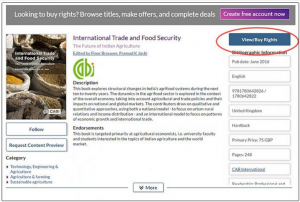
In this demonstration page from IPR License’s Instant Rights program, you can see a title’s “Buy Rights” button circled in red, upper right. Image: IPR License

Indeed, the rights buyer anywhere in the world can go ahead and actually purchase the rights online, following approval by the rights seller. The system is integrated with the e-commerce Stripe software and with VAT calculation so that if everything qualifies, the buyer can simply check out with the purchase of the rights.

If the publisher has the manuscript ready, the buyer can download it on the spot.

‘Under the Rights Owners’ Control’
 

Publishers selling rights can decide which types of rights deals are handled automatically by Instant Rights, and which inquiries will be put through directly to their rights team.  Click here to read the entire article.


Leave A Message

BookExpo’s Trade Floor: Spacious, Smaller, and Talking OptiQly

Published on June 2, 2017 | In Blog, News | 0 Comment

In Publishing Perspectives Feature Articles by Porter Anderson June 2, 2017  (abbreviated article)
 
Optimization, IQ: Sales

Peter McCarthy

At the Javits Center, Publishing Perspectives spoke with Peter McCarthy, chief product officer, and Susan Ruszala, vice president for sales, about what this new subscription analytical platform offers.

McCarthy is familiar for his years in publishing houses’ digital marketing developments and, most recently, as the partner of Mike Shatzkin in the Logical Marketing consultancy. Shatzkin appears on OptiQly’s team list, too, as strategist, and has written about the product as it neared its release.

Ruszala was last seen most prominently as president of NetGalley and presided over its international expansion, which included the March 2016 roll-out in Germany, prior to her new role with OptiQly.

Susan Ruszala

Both Ruszala and McCarthy now are working with OptiQly CEO Evan Schnittman and general counsel Jon Fine on this interesting project with the challenging name. Jess Johns is the marketing lead, Didier Jean Charles is chief of tech, and David Joseph is handling finance and operations.

Ruszala and McCarthy say the name carries elements of optimization and IQ, although as yet it seems hard for some to remember, spell, or understand.

But in talking with them, it becomes clear that the capabilities they attribute to OptiQly may well have potentially pivotal value for publishers—and eventually for traditionally and self-publishing authors, as well—if its promise is borne out in its execution.

“It may be a few months,” however, cautions Ruszala, before single-title users will be invited to subscribe. “We want to be sure we’re ready to service that community,” she says.

In this screen shot, you see the OptiQly software’s Amazon.com book sales page overlay referencing various factors of marketing analysis. Image: Provided by OptiQly

‘To Promote Transparency’
“What we’re good at doing is surfacing a lack of alignment. And that’s either a problem or an opportunity.”Peter McCarthy, OptiQly

To be simplistic for the sake of clarity, OptiQly can be thought of as a diagnostic tool for how a book is positioned, specifically in the Amazonian jungle of bookselling today. While the team would like to bring more retail platforms into play eventually—including Amazon’s international sites—Ruszala and McCarthy say the effort as OptiQly approaches its step-out into the marketplace is on US Amazon, the biggest books retailer out there.

Using an algorithmic assessment of factors including retail performance at Amazon.com, a book’s sales page, Web and social activity relative to the title, and performance by competitor titles, the program is meant to “promote transparency to improve marketing performance,” in the language of OptiQly’s early promotional copy.

The program then has instructional responses, telling a publisher how to adjust various conditions to enhance performance: how to fix it, in other words.

“We’ll launch sometime in mid-June with a product people can play with, experiment with,” Ruszala says, “with a subscription edition available sometime in August.”

“And what OptiQly does,” McCarthy says, “is enable the marketer to see 50 or so factors that affect the marketing funnel, data points, that we roll up with an algorithm into scores. The scores relate to an overall score and relate to your brand, too. Scores are zero to 100.”

Both publishers and authors will be interested in the distinction McCarthy is making there. What in OptiQly’s lexicon is the “product authority” is the score relative to how well the title is positioned. The second score is “brand authority,” a score relative to the author’s visibility.

A central spot on the trade floor at BookExpo on Thursday (June 1). Image: Porter Anderson

‘Insights and Actions’
“We’re looking at the impact of a lot of factors that are outside of Amazon and important to being discovered online.”Susan Ruszala, OptiQly

“We chose Amazon,” Ruszala says, “not for any particular affinity with Amazon but because there’s so much data available and their merchandising algorithm is so sophisticated.

“A lot of the early work around OptiQly came out of work Pete was doing to say, ‘What are the factors that cause my title to move more rapidly within the Amazon environment? What’s important to the way that they will start to merchandise a book?—in their emails or in advertising or in keyword marketing or on the site itself?'”

McCarthy says that rather than scraping data from sales pages as is done, for example, by the Author Earnings project, “We get 99 percent of our data from feeds, and doing just a tiny amount of scraping.”

“And it’s not just Amazon data,” Ruszala says. “We’re looking at the impact of a lot of factors that are outside of Amazon and important to being discovered online.”

At a more granular level, some of the factors OptiQly is said to parse include:

  • Goodreads activity (title and author);
  • Wikipedia page views (author);
  • Facebook and Twitter shares;
  • Price history;
  • Sales rank;
  • Consumer reviews on Amazon.com;
  • Category placement;
  • Amazon search rankings;
  • Availability;
  • Author page and rank at Amazon.com
  • Key marketing assets;
  • Page structure assessment; and
  • Keywords.

As McCarthy points out, all these and more are used by Amazon, itself. “The easiest way to explain it is to say that they work largely off of page views and conversion. They want to see that ratio. And a lot of the signals that indicate page views are the things Susan is talking about,” those outside signals such as social-media shares.

“Facebook links back to the product,” McCarthy says, “the number of shares out there that link back to Twitter, just shares in general. All of those things are going into defining page views as going up or down. Sales rank is going to tell you whether or not it converted.

“So what you want to see if you’re a marketer,” McCarthy says, “is alignment. What we’re good at doing is surfacing a lack of alignment. And that’s either a problem or an opportunity.”

A section of the program is called “insights and actions,” which are data-driven analytical casework: “If that’s true and that’s true” about a book’s sales and other factors, as McCarthy puts it, “go try one of these things” to see if a title’s performance can be upgraded.

‘Which Titles Have a Misalignment’

Initially, say McCarthy and Ruszala, a subscription may offer the chance to track, say, 50 ISBNs for a modest monthly fee, around $150, with bigger packages available. That’s because, the initial target customer, a publishing house, is expected to find OptiQly important for determining where to focus marketing attention.

This is something Shatzkin has written about on the subject, as its strategist, saying:

“[The product] will really be indispensable to help larger publishers figure out every morning which of their titles can yield the biggest dollar improvements with tweaks or fixes their marketers can apply today.

“It will point publishers to which titles on their list have a misalignment that, if corrected, will immediately boost sales.

“And, by title, it will tell them exactly what actions will yield results.

Once the system is up and running, subscribers will be able to use it to track performance scores for others’ titles, not just their own, a potential boon in terms of analyzing what another book is doing right or wrong—information to be applied or avoided.

And the over-arching intent here is to capture and refine the most optimal conditions for a book to be discovered and for that discovery to be converted into sales. Too frequently, Ruszala and McCarthy say, publishers just aren’t able to track enough factors and discern enough about a title’s marketplace positioning to know what’s working and what’s not.

“It’s a lot like having a bunch of people going into a bookstore,” McCarthy says, “and your book is shelved in the back, in the wrong category, maybe spine out but the spine is scratched” and unreadable.

And even if a publisher’s staff could do the kind of research it would take to check out and monitor the factors that OptiQly is meant to follow, the time commitment and work level would be prohibitive.

“Multiply the number of data points by the number of SKUs” in a publisher’s list, McCarthy says. “It’s huge.

“OptiQly rolls it all up.”

The Quarto Group bus is on the trade floor at BookExpo. Image: Porter Anderson

About the Author

Porter Anderson

Facebook Twitter Google+

Porter Anderson is Editor-in-Chief of Publishing Perspectives. Prior to that he was Associate Editor for The FutureBook, a channel at The Bookseller focused on digital publishing. Anderson has also worked with CNN International, CNN.com, CNN USA, the Village Voice, the Dallas Times Herald, and other media.

Leave A Message

© 2026 Molly Brave, LLC. All Rights Reserved.

  • Store
  • Blog
  • Privacy Policy
  • Disclaimer
  • Terms of Use
  • Contact