Join Our Family
My Account
Molly Brave logo
  • Home
  • About Us
  • Store
  • Blog
  • Activities
  • Contact
  • Blog

    • All Categories
    • For Parents and Teachers
    • Recommended Books
    • Resources
    • News
    • Mentorship With Mary Alice – An Introduction
      • How To Begin Writing For Children
    • Independent, Hybrid and Self-Publishing

Blog

For Parents and Teachers

Notes From the Horn Book, news about good books for children & young adults

Published on June 22, 2017 | In Blog, For Parents and Teachers, Recommended Books | 0 Comment

The Horn Book Magazine, founded in Boston in 1924, is the oldest of the U.S. magazines dedicated to reviewing children's literature.

Horn Book's free e-newsletters are perfect for teachers, librarians, parents, and anyone else who is looking for new good books for children and teenagers. Each issue is written and published by Horn Book editors, the most trusted authorities in the field. When you sign up for Notes from the Horn Book, you’ll automatically receive Nonfiction Notes from the Horn Book, The Horn Book Herald, and Talks with Roger. Subscribe today — it’s free.

Published monthly, Notes features the best in newly released children’s books for every age. Distributed six times a year, this nonfiction-only newsletter features themed topics and book reviews. The Herald, published six times a year with JLG, brings up-to-date information on award winners, holiday books, & more. An occasional — and lively! — sponsored newsletter in which editor in chief Roger Sutton interviews an author or illustrator.

Caldecott | Newbery | Printz Blogs

  • Dear Robin
  • Caldecott Club
  • Readers, meet Triangle
  • On the Radar
  • The Good, the Bad, and the Self-Published: Could an Indie Picture Book Win the Caldecott?
  • “Does photographic illustration get its due?”
  • Egg
  • On the Radar
  • A Different Pond
  • It’s Raining Books

Leave A Message

Reading with children starting in infancy gives lasting literacy boost

Published on June 21, 2017 | In Blog, For Parents and Teachers, News | 0 Comment

Shared book-reading that begins soon after birth may translate into higher language and vocabulary skills before elementary school.

Date: May 4, 2017 Source: American Academy of Pediatrics, in Science Daily

Summary: New research shows that reading books with a child beginning in early infancy can boost vocabulary and reading skills four years later, before the start of elementary school.

New research at the 2017 Pediatric Academic Societies Meeting shows that reading books with a child beginning in early infancy can boost vocabulary and reading skills four years later, before the start of elementary school.

The abstract, "Early Reading Matters: Long-term Impacts of Shared Bookreading with Infants and Toddlers on Language and Literacy Outcomes," will be presented on Monday, May 8, at the Moscone West Convention Center in San Francisco.

"These findings are exciting because they suggest that reading to young children, beginning even in early infancy, has a lasting effect on language, literacy and early reading skills," said Carolyn Cates, PhD, lead author and research assistant professor in the department of pediatrics at New York University (NYU) School of Medicine. "What they're learning when you read with them as infants," she said, "still has an effect four years later when they're about to begin elementary school."

Mothers and their babies were recruited from the newborn nursery of an urban public hospital, with more than 250 pairs monitored between ages of 6 months and 4 and a half years (54 months) for how well they could understand words, and for early literacy and reading skills. The study was funded by the Eunice Kennedy Shriver National Institute of Child Health and Human Development.

The findings were compared with the quantity of shared book-reading, such as the number of books in the home and days per week spent reading together. Quality of shared book-reading was gauged by asking whether parents had conversations with their child about the book while reading, whether they talked about or labeled the pictures and the emotions of the characters in the book and whether the stories were age-appropriate.

Adjusting for socioeconomic differences, the researchers found that reading quality and quantity of shared book-reading in early infancy and toddlerhood predicted child vocabulary up to four years later, prior to school entry. Book-reading quality during early infancy, in particular, predicted early reading skills while book-reading quantity and quality during toddler years appeared strongly tied to later emergent literacy skills, such as name-writing at age 4.

The results highlight the importance of parenting programs used in pediatric primary care that promote shared book-reading soon after birth, Dr. Cates said, such as Reach Out and Read and the Video Interaction Project.

Dr. Cates will present the abstract, "Early Reading Matters: Long-term Impacts of Shared Bookreading with Infants and Toddlers on Language and Literacy Outcomes," at 8:15 a.m.


Story Source:

Materials provided by American Academy of Pediatrics. Note: Content may be edited for style and length.

American Academy of Pediatrics. "Reading with children starting in infancy gives lasting literacy boost: Shared book-reading that begins soon after birth may translate into higher language and vocabulary skills before elementary school." ScienceDaily. ScienceDaily, 4 May 2017. <www.sciencedaily.com/releases/2017/05/170504083146.htm>.

Leave A Message

Scholastic News Online

Published on June 19, 2017 | In Blog, For Parents and Teachers, Resources | 0 Comment

Welcome, Teachers

ALL GRADES

Reading Club

Book Wizard

Daily Starters

The Teacher Store

Browse free teaching resources by grade


Leave A Message

Sight Words Are So 2016: New Study Finds the Real Key to Early Literacy

Published on June 11, 2017 | In Blog, For Parents and Teachers, News | 0 Comment

written for parent.co by
Kate Koch-Sundquist posted on April 12, 2017  Click here to read the entire article on the importance of invented spelling.

It’s no secret that teaching a child to read is a pretty big deal. Research has proven again and again that children who grasp early literacy skills by the end of first grade become strong readers for the rest of their lives, while those who struggle early on continue to do so throughout their schooling. So, no pressure, right?

This is exactly why, when it came time to choose a focus for my career in education, I opted for the upper elementary grades. Multiplying fractions? Thesis statements? Identifying the author’s purpose? Those I can handle. Reading? No, thank you.

But as the mom of two preschoolers, early literacy skills are back on the table now.

Last year, I sat across from my son’s preschool teacher as she calmly shrugged and told me that he wasn’t yet showing interest in letter recognition nor writing his own name. On the surface, I copied her even, close-mouthed smile and nodded as she assured me that this was not unusual for a boy his age. On the inside, I felt my heart pound while I mentally outlined the things I should have been doing at home to encourage his early literacy.

A year later, though, with no interventions from me or his teacher, my son began to write his name and became obsessed with letters, letter sounds, and letter recognition. He just needed the time and space to come to this understanding himself.

We were lucky that his fall birthday meant he narrowly missed the kindergarten cut off and had an extra year in preschool. We were lucky he was given the time and space to come to his own understanding in his own time.

But what happens when time and space aren’t available? What happens when children in kindergarten are pushed towards early reading, even if they are not developmentally ready?

A 2010 article in the Harvard Education Letter points out that modern children are still meeting developmental milestones at the same ages as children studied in the 1920s. That is, children’s abilities have not changed over the past century. The educational standards they’re held to have, however.

With the introduction of Common Core Standards, kindergarteners are now required to read, write, and even participate in research projects. This is a stark contrast to the play-based kindergarten of the 1980s. Is the emphasis on sight word memorization and explicit reading instruction misguided?

A new study seems to point to yes.

Published in the January 2017 issue of the journal “Developmental Psychology”, the study concludes that the most valuable early literacy skill to encourage in kindergarten is neither alphabetic knowledge nor memorization of key sight words. In fact, it’s not a reading skill at all.

The best indicator of future success as a reader is actually a child’s ability to use invented spelling as he writes.

"Results supported a model in which invented spelling contributed directly to concurrent reading along with alphabetic knowledge and phonological awareness."  (PsycINFO Database Record (c) 2016 APA, all rights reserved)

Leave A Message

Landmark Study Finds Better Path to Reading, proves what exemplary teachers have been doing correctly for years!

Published on June 11, 2017 | In Blog, For Parents and Teachers, News | 0 Comment

J. Richard Gentry Ph.D.

In a landmark study two Canadian researchers in developmental psychology, Gene Ouellette and Monique Sénéchal (2017), have mapped the powerful beginning reading-writing connection, moved us closer to being successful teachers of reading in first grade, and cleared up decades of confusion. It’s important because reading scores in first grade have flatlined for decades—especially in the United States. This study can move us forward.

As far back as 1982 Marie Clay, the late world-renowned expert in developmental and clinical child psychology who founded Reading Recovery, issued a call for educators to find the writing connection in learning to read (Clay, 1982). Could teachers and parents capitalize on the potential for beginning writing to complement learning to read? Should we be encouraging pencil and paper activity from the very beginning?

Ouellette and Sénéchal have mapped out the way. Counterintuitively, it turns out that allowing and encouraging children’s early “invented spelling”—a much maligned and controversial practice in some quarters—is the key.

What is Invented Spelling?   Click here to read the Psychology Today article.


Leave A Message

Raising Sensitive Children to be Future Leaders; The Highly Sensitive Child

Published on June 11, 2017 | In Blog, For Parents and Teachers, Recommended Books | 0 Comment

By Amy Monticello for The Quiet Revolution blog

My 3-year-old daughter, Benna, and I sit on the floor of her bedroom, having a tea party. Like much of our play, this party has rules. Conventionally, we use Benna’s pink play tea kettle and invite a rotating selection of her extensive stuffed animal menagerie, but unconventionally, we only drink “tea” from a large plastic bucket in the shape of a pumpkin that Benna used this year for trick-or-treating. The reason? Benna doesn’t want to spill any “tea” on the floor. She understands that a larger vessel is a better safeguard against spillage.

But as Daniel Tiger teaches, accidents happen. “Have some more tea, Mama,” Benna says, tipping the kettle that makes actual pouring sounds towards the bucket. And then: “Oh no! I spilled some tea!” We grab a dishtowel and clean up the invisible wetness from the rug. “All fixed,” she says, satisfied and ready to party on.

I’ve come to understand these fictitious spills as a form of safe play for my daughter, whose reaction to real spills—messes or disarray of any kind—mirrors mine. Activity grinds to a halt so that the incongruity can be rectified: the errant crayon mark erased, the drop of milk wiped from the table. My husband compares this to when, mid-sentence, I’ll get up to collect a dust bunny I spy across the room. Or straighten a lampshade. Or even out the mini-blinds. My daughter and I share this compulsive response to our environment just as we share the same underlying personality structure of which this behavior is but one small incarnation: high sensitivity.

In her seminal tome, The Highly Sensitive Child, Dr. Elaine Aron outlines the four main identifiers of high sensitivity: engaging in deep reflection, becoming easily excited or overwhelmed, having high emotional responsiveness and empathy, and noticing elusive or understated detail. In the updated 2014 author’s note, she further explores earlier research about the correlation between high sensitivity and unhappiness. “I suspected this had something to do with a person’s history, with sensitive persons being especially affected by stress when young, and that is what we found,” Aron says. “However, with a good enough childhood, they were as happy as others and perhaps even more so than others.”

When I was a child, my family gave me the nickname Sarah Bernhardt, after the Victorian-era actress whose melodramatic performances earned her equal parts admiration and scorn. Sensitive was a word frequently used to describe what my family thought were my over-the-top responses to commonplace things like the sound of bumblebees, the grit in the dentist’s toothpaste, and the texture of rare roast beef.

As a teen, I was tormented by any shift in the dynamics of my relationships, more often perceived than outright stated. Able to detect when a friend was pulling away, I’d become needy and clingy, obsessed with ferreting out my status. Even now, my mother accuses me of hearing slights that aren’t there, of making too much of a passing comment from a family member. I’ve lost countless hours of sleep to turning over such comments in my head, fixating on the hint of sarcasm, disdain, or judgment that I swore I heard in their words, however banal.

I had a happy childhood. I grew up knowing I was loved, and my sensitivity was a gateway to deep and meaningful relationships more than it was a liability in them. But I did develop a sense of myself as thin-skinned, weak-willed, and dramatic. And I’ve struggled with depression and anxiety throughout my adult life. I’ve coped in healthy ways with writing and exercise, but my coping methods have also included alcohol, marijuana, and prescription medication. One of my biggest fears is that my daughter will rely on these latter methods too.

Aron’s research offers me comfort that sensitivity need not be a lifetime sentence to mental illness, especially since my husband and I have access to emerging research that can guide our parenting. We know that yelling is not only ineffective in discipline with all kids but also likely to escalate our own sensitive child’s distress. We know to avoid peak hours at shopping malls and restaurants. When we host playdates, we know that Benna will spend the first hour or so alone in her bedroom, acclimating to the noise and activity of other children in our home. Most importantly, we know how to recognize all the gifts of Benna’s sensitivity: her ability to name and discuss abstract feelings, her unusual proclivity for sharing, her razor-sharp memory, her love and need of quiet time, her orderliness and cleanliness, her unrestricted affection for those she trusts.

But our culture’s perception of weakness in high sensitivity, and the monikers that arise from it (like calling people special snowflakes), have found new reinforcement in a growing cultural trend characterized by an overt backlash against political correctness and asylum. Particularly on social media, we see a relished mockery of any reference to safety or the protection of others’ feelings through choices in language and tone. Many Americans seem bent on building a collective thicker skin through a combination of intimidation, bullying, and gaslighting.

I am grateful that Benna is still young and that for now her parents’ influence remains the governing force of her self-perception. Research shows that peer expectations begin to supplant parental expectations when a child enters full-time schooling. In The Nurture Assumption, psychologist Judith Rich Harris stresses the importance of children’s ability to navigate their culture at large, outside the home, and thus the enormity of that culture’s impact on personality development.

With a trend towards emotional toughness, attacks on perceived sensitivity seem likely to increase, with potentially serious effects on those with high sensitivity. And yet, other repercussions of callousness might best be remedied in part by people like my daughter. In “The empathic civilization“, a TED Talk that connects human empathy to the urgency of environmental conservation, Jeremy Rifkin says that, “Empathy is the invisible hand. Empathy is what allows us to stretch our sensibility with another so that we can cohere into larger social units.” In other words, empathy, a hallmark characteristic of those with high sensitivity, could be an antidote to an increasingly fractious world that values insularity.

Not only do I want Benna to reject the notion of sensitivity as a character flaw, I want her to see it as a source of joy. Sociologist Brené Brown says that vulnerability—in her definition, a willingness to be seen—is essential to living a “wholehearted” life, and highly sensitive people often have no choice in being vulnerable. “Vulnerability sounds like truth and feels like courage,” Brown says. “Truth and courage aren’t always comfortable, but they’re never weakness.”

There’s another game we play with Benna’s stuffed animals that I privately call The Feelings Game. Benna will hold up Hedwig the Snowy Owl, or Beulah the Elephant, or her dearest friend Big Bear, and tell me what they’re feeling. “Beulah’s excited!” she’ll say, or “Big Bear is very tired.” She also tells me when they’re angry or upset. “Hedwig is sad,” she’ll say. Sometimes we give Hedwig a hug or fix her dinner, but most of the time, I just say I’m sorry that Hedwig is sad. We start with acceptance—that necessary precursor to honor, to value.

And every time, Benna will then say, “Hedwig’s happy again!”

Leave A Message

Text This Number to Find Free Summer Meals for Hungry Kids

Published on June 6, 2017 | In Blog, For Parents and Teachers, Resources | 0 Comment

By Evie Blad on June 6, 2017 3:27 PM

A quick text message can help families locate nearby federally supported summer meals sites, which are designed to meet the nutritional needs of children who rely on school lunches and breakfasts during the school year.

Text "food" or "comida" to 877-877 and you will receive a prompt to reply with your address or zip code. The service then pulls active summer-meal sites from a U.S. Department of Agriculture database and sends you a list of nearby locations.

"Last year only about 16% of the kids who rely on free/reduced meals during the school year were getting meals in the summer," No Kid Hungry says in a release. "One major obstacle: Many families either don't know the program exists or don't know how to find sites."

Summer meal programs, hosted by schools and approved non-profit organizations, offer free meals to children in areas where 50 percent or more of students qualify for free or reduced-price lunches. In some cases, those meals are offered from trucks and buses that go into low-income neighborhoods where children may lack transportation to meals sites.

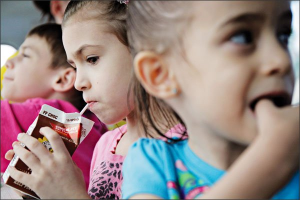
Photo: Nicohles, Destiny, and Desiree Kleis, from left, ate lunch inside the lunch bus, a free summer meal program in Pasco County, Fla. in 2014. A growing number of school districts are creating mobile meals programs to keep children well-fed over the summer. --Melissa Lyttle for Education Week

Read the entire article here

Leave A Message

“Daddy Matters,” a 4-part web series launches today

Published on June 2, 2017 | In Blog, For Parents and Teachers, News | 0 Comment

ZERO TO THREE has teamed up with YouTube star La Guardia Cross to create “Daddy Matters,” a 4-part web series that launches today with new episodes every Friday through the month of June. We'll kick things off with a Facebook Live tonight at 7pm Eastern. Please join us! 

Daddy Matters explores why dads matter and what matters to dads. La Guardia is the creator of New Father Chronicles which captures life with his adorable young daughters. His candid and always comedic take on life as a dad has drawn millions of engaged viewers and sparks lively conversations on his social media channels. La Guardia was named to Ebony’s Power 100 list and is a leading national voice for dads.

Daddy Matters episodes are supremely entertaining and at the same time serve as great discussion-starters about important ways dads support their children’s early development. Check out episode 1 that addresses the adjustment to fatherhood and learning from the inevitable mistakes all parents make. 

One of the best ways to support young children is to support their parents. Cross and ZERO TO THREE hope viewers will tune in and use the Daddy Matters series as a way to start important conversations to help dads get the respect and support they deserve. More information is available at zerotothree.org/DaddyMatters, and everyone is invited to join the conversation on social media with #DaddyMatters.

Daddy Matters was inspired by previous ZERO TO THREE research.

Dads love fatherhood, are more engaged with their kids’ development, and crave more conversations with each other. Ninety percent of dads say being a parent is their greatest joy, and 73 percent say their lives began when they became a dad. More than half (54 percent) say “I love you” more and 47 percent read more to their child than they recall their own parents did. Still, six in 10 fathers agree that dads don’t get enough credit for their involvement in raising and caring for young children. Dads want to hear and learn from each other about the challenges and the triumphs and everything in between. Learn more: Tuning In: Parents of Young Children Tell Us What they Think, Know and Need.

Leave A Message

Why Kids Need to Learn How to Forgive

Published on June 2, 2017 | In Blog, For Parents and Teachers | 0 Comment

“Bitterness is like cancer,” the poet Maya Angelou told Dave Chappelle in an interview. “It eats upon the host. It doesn’t do anything to the object of its displeasure.”

No hard feelings

Forgiveness has roots as both a spiritual and a secular teaching in Western culture. In the last 40 years, it has become a subject of academic study as researchers have investigated the impact of forgiving—and not forgiving—on the relationships, health, and happiness of those who have suffered a range of traumatic experiences. But despite the evidence that forgiving is good for you, forgiveness has an image problem, which stems, say researchers, from a misunderstanding of what forgiveness is and isn’t.

According to the American Psychological Association, forgiveness is a voluntary, deliberate change in feeling toward someone who has caused you hurt or harm; it involves letting go of negative emotions toward the offender and results in a decreased desire for retaliation or revenge.

It’s not saying that the offense was okay. Forgiveness is often thought to be a weak response that condones, minimizes, or excuses wrongdoing. These are all misconceptions, says Loren Toussaint, professor of psychology at Luther College and co-editor of Forgiveness and Health: Scientific Evidence and Theories Relating Forgiveness to Better Health.

Forgiveness doesn’t require that the other person apologize. And it doesn’t have to (and sometimes shouldn’t) result in reconciliation. Forgiveness simply means you’re letting go of feelings of resentment and vengeance. You’re refocusing your thoughts on positive emotions; perhaps even feelings of understanding, empathy, and compassion toward the person who hurt you.

“Forgiveness is not making up with a wrongdoer if they are likely to hurt you again,” explains Toussaint. “Forgiveness is about feeling better as a person.”

If your child is hurt by a sibling or a bully, it is critical that the hurt party is protected and the perpetrator is disciplined appropriately. But, assuming the offense is dealt with justly, when a child feels lingering anger and hurt, forgiving is what will help them recover—from that hurt, and maybe others as well.

A study of six to nine year olds in Belfast conducted by Robert Enright, professor of educational psychology at University of Wisconsin–Madison, found that students who learned to forgive reduced their anger in general toward everyone, not just toward the person who harmed them.

Why forgiveness works for kids

More on Forgiveness & Kids

Discover how forgiveness makes kids happier.

Explore nine ways to help siblings get along better.

Learn how to raise forgiving kids.

How forgiving are you? Take our quiz and try these forgiveness practices.

When kids are wronged and don’t forgive, they remain “stuck” in the traumatic situation when they felt victimized. Every time they recall the hurtful event, they re-experience their stress response. If they dwell on their resentment, they continue to release stress chemicals, such as adrenaline, cortisol, and norepinephrine into their brains. This activates the amygdala and other primitive brain regions involved in survival emotions such as fear and rage. The result is an inhibition of the brain’s problem-solving ability, creativity, reasoning, and impulse control.

What happens in the brain when a person forgives is a very different picture. In University of Sheffield research using fMRI scanning, forgiveness exercises helped activate brain regions that feel empathy and make moral judgments. A University of Pisa study found that participants who contemplated forgiveness exhibited activation in five brain regions, indicating an increase in positive emotions, cognitive morality, understanding of the mental states of others, perception, and cognitive control of emotions. Although the research participants were young adults, studies indicate kids’ brains are wired similarly for moral reasoning and empathy.

Children who learn how to forgive also gain an edge academically, and the reason may be as simple as having more energy available to focus on constructive pursuits. Their brains aren’t fuming, recounting the hurt, and plotting revenge; instead, they’ve got a clean slate where they can organize information and think creatively.

A study conducted by Enright found that counseling sessions dedicated to teaching forgiveness had significant academic benefits for at-risk teenagers. Twelve middle school students who had each experienced life-altering hurts were tested before and after a 15-week program in Forgiveness Counseling, with astounding results. The kids showed measured improvement in written English, math, and social studies; in their attitude toward school and their teachers; and in their relationships with their parents and other kids.

“Research supports the connection between forgiveness and improved academic functions,” Toussaint says. “The negative emotions of unforgiveness can be powerful detractors from children’s attention and focus in the classroom and in their individual studies.”

Leave A Message

The First 1000 Days | Johan Morreau, M.D. | TEDxTauranga (Video)

Published on June 2, 2017 | In Blog, For Parents and Teachers | 0 Comment

The quality of the first 1000 days of a child's life will determine the quality of the next 32,000 days.  That first thousand days are a window of opportunity for a child, for a family, and for a country.  What are the consequences of neglecting the first 1000 days?  A New Zealand perspective.  Are Finland and Holland doing a better job?  "Money invested in an infant will generate a happier, healthier and longer life.  A dollar spent in early childhood saves around $17 of later government spend.  We have to invest in parenting... whatever it takes to purify a pregnancy, generate attachment, bonding and brain growth, and create a happy, healthy child with aspirations.  Let's spend our money on parenting, not on prisons."  Watch the video here.

Leave A Message

« Previous 1 2 3 4 5 6 Next »

© 2026 Molly Brave, LLC. All Rights Reserved.

  • Store
  • Blog
  • Privacy Policy
  • Disclaimer
  • Terms of Use
  • Contact